



iPhone users
Share photos as a document
Combine photos into one PDF for upload forms or recipients who cannot open HEIC files.
Turn iPhone photos into a PDF. Arrange, rotate, and preview before saving.
Drag to reorder. Click an image to select it.
Add more images, or undo to bring them back.
Use the page controls to inspect your document.
Save your result or return to adjust the settings.
Upload HEIC or HEIF photos, or try the sample. Each file contributes its main photo.
Arrange, rotate or remove images, then choose paper, margins and image fit.
Select Start, then download your PDF. You can return to make more changes.
HEIC to PDF turns HEIC and HEIF photos into one document. Add iPhone pictures, arrange the visible pages, and choose a layout for sharing, uploading or printing. No separate JPG conversion is needed.
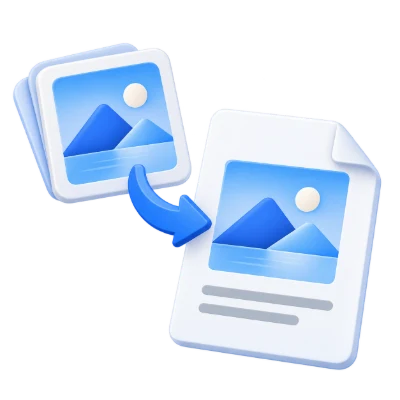
Combine photos into one PDF for upload forms or recipients who cannot open HEIC files.
Arrange photographed receipts, rotate sideways pictures, and add margins for a readable expense attachment.
Bring worksheets, handwritten notes or keepsake photos together in one PDF. Review every page before sharing.
Use the main photo from each file, with its stored rotation and mirroring applied.
The server decodes the primary still image, then sends a prepared PDF page to the browser. Embedded thumbnails, depth images and other auxiliary images do not become extra pages.
Image pixels are kept at their decoded dimensions. Embedded ICC color profiles are converted to sRGB; higher-bit-depth photos are prepared as 8-bit images. Camera metadata is not copied into the resulting image.
Drag thumbnails into order and add more photos when needed.
Each uploaded file starts as one page. Drag to reorder, sort by filename, or reverse the order. Open an enlarged preview to inspect a photo. All remaining pages are included when you save; selected thumbnails only control editing actions.
Select images for changes while keeping the full output order visible.
Selection controls which thumbnails an action changes; it does not limit the download to selected thumbnails. Rotate individual images, duplicate useful pages, remove unwanted frames or move a selection to the beginning or end. Range, odd/even and inverse selection speed up batches. Undo and redo let you revise the board before export.
Choose original sizing or a paper preset, then adjust the surrounding space.
Set paper size, orientation, margins and page background color. Contain keeps the whole image visible and may leave empty space; Cover fills the available area and can crop image edges. Automatic orientation follows the image. Check the enlarged preview before exporting, especially when photographs have different proportions.
Download one PDF, preview it, or return to revise the layout.
Choose Start to create the PDF from your arranged pages. Preview opens that actual result; Back preserves your board so you can revise it. Start over clears the workspace.
Photographed English, Arabic and other scripts remain visible as image pixels. Conversion does not recognize text, preserve Live Photo motion or create an HDR photo archive.
Add up to 50 files, at most 50 MB each and 200 MB combined. Each image must be no wider or taller than 10,000 pixels. The workspace and output are limited to 200 pages, including frames and duplicates.
Photos are uploaded for preparation. Arrange pages and create the final PDF on your device.
Know what to expect before you start.
Server + your deviceUpload the HEIC or HEIF file, arrange its page, and choose Start. Download saves the resulting PDF. You can upload several photos together.
Yes. Add photos to the same workspace, reorder their thumbnails, and save one PDF. You can rotate, duplicate or remove pages before export.
The main photo is decoded at its original pixel dimensions, with orientation applied. ICC-tagged colors are converted to sRGB and high-bit-depth images become 8-bit. HDR effects can look different. Contain keeps the whole image visible; Cover can crop its edges.
Only the primary still photo in each file is included. Videos, auxiliary depth or gain maps, and additional images stored in the same container are not exported as separate pages.
Text photographed in the image remains visible in any language, including Arabic. It is not searchable or editable text. Use PDF OCR after conversion when you need text recognition.
Use up to 50 files, 50 MB each and 200 MB combined. Each image can be up to 10,000 × 10,000 pixels. The output limit is 200 pages, including duplicates. Removed source files still count toward workspace limits until Start over.
HEIC decoding uses our servers. The prepared pages return to your browser, where reordering, layout changes and final PDF creation take place.