


Students
Combine coursework PDFs
Join assignments, notes and supporting material in your chosen file order. Select ranges when only part of a document belongs in the submission.
Combine documents into one PDF, exactly your way.
Add PDFs, arrange their order, then refine individual pages below the preview. Processing stays on your device. Filled form values are preserved as page content.
Drag documents into order. Keep every page, or choose a range from each file.
Add PDFs, or undo to bring your pages back.
Tip: use Alt + arrow keys to move a focused card. Ctrl/⌘ + Z undoes your last change.
Your documents, arranged in one PDF. Preview the result or download it below.
Choose multiple PDFs, or start with one and add more in the workspace.
Arrange documents, choose pages, and pick a merge order.
Choose Start, then preview or download your new PDF.
Merge PDF files with a visual document workspace. Add multiple PDFs, arrange their order, choose specific page ranges, and rotate whole documents before combining them. Use alternating pages to interleave documents such as separately scanned fronts and backs. Review the output sequence, name your file, and download one PDF. Processing stays in your browser, and text remains selectable.
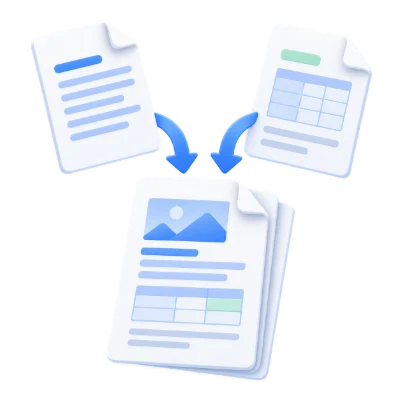
Join assignments, notes and supporting material in your chosen file order. Select ranges when only part of a document belongs in the submission.
Create one PDF packet for a proposal or internal report. Review the output order and page rotations before downloading.
Use alternating pages to interleave separately scanned sides. Inspect the sequence so each front is paired with its intended back.
Combine complete PDFs or selected pages from each source.
Add PDFs to the document board and check their cover thumbnails and source labels. Change the document order by dragging, filename sorting or reversing the list. Each source has its own page range and rotation. Descending ranges can reverse the chosen pages from that document without reversing every other source.
Use ordinary concatenation or weave pages from several PDFs together.
Sequence places the selected pages of the first file before the next file. Alternate takes pages in turn from the sources, which can help combine separately scanned fronts and backs. The output strip shows the resulting sequence. Check it before starting, especially when documents have different numbers of pages.
The operation works with PDF pages rather than screenshots.
Text and vector artwork remain in PDF form where supported. The original file on your device is not overwritten. Interactive forms, annotations, links and document-level navigation can behave differently in a newly assembled document, so check the generated PDF before sharing it. Page rearrangement is not redaction of information inside retained pages.
Preview the result before downloading and sharing it.
Select Start when the settings are ready. On the result screen, Preview opens the generated PDF and Download saves a separate copy. Back returns to the current workspace; Start over clears it for a new file. Review small text, page edges and page order in the finished copy. A new PDF does not preserve the validity of an existing digital signature.
Add up to 25 PDFs, at most 300 MB each and 300 MB combined. Removing pages can reduce the output, but does not bypass the initial loading limits. Up to 750 source pages. Generated PDFs have no fixed page-count or file-size cap. Input and processing limits still apply.
Processing takes place on your device without uploading the document. Download your result before closing the page; keep the original separately.
Know what to expect before you start.
On your deviceAdd PDFs to the document board and check their cover thumbnails and source labels. Change the document order by dragging, filename sorting or reversing the list. Each source has its own page range and rotation. Descending ranges can reverse the chosen pages from that document without reversing every other source.
Sequence places the selected pages of the first file before the next file. Alternate takes pages in turn from the sources, which can help combine separately scanned fronts and backs. The output strip shows the resulting sequence. Check it before starting, especially when documents have different numbers of pages.
Add up to 25 PDFs, at most 300 MB each and 300 MB combined. Removing pages can reduce the output, but does not bypass the initial loading limits. Up to 750 source pages. Generated PDFs have no fixed page-count or file-size cap. Input and processing limits still apply.
Document processing and PDF generation run in your browser on your device. This tool does not upload the document for processing. Save your result before closing or reloading the page; the original file on your device is unchanged.