


Developers & technical writers
Share documentation outside the repository
Turn a README, installation notes or release brief into a PDF with readable headings, code blocks and tables.
Write in Markdown. See your ideas take shape. Download a clean, beautifully formatted PDF.
Start writing, open a Markdown file, or explore a ready-made example.
Add Markdown on the left to see the formatted document.
Use the page controls to inspect your document.
Your formatted PDF is ready. Download it or go back to continue writing.
Start with a blank document, upload a .md, .markdown or .txt file, or try the example.
Edit your Markdown and choose a document style, page layout, type size and reading direction.
Create the PDF on our servers, preview the finished pages and download. Use Back to keep editing.
Use this free Markdown to PDF converter to turn a README, project brief, study notes or technical documentation into a formatted document. Edit the Markdown source, see a live preview and choose a page style before creating your PDF.
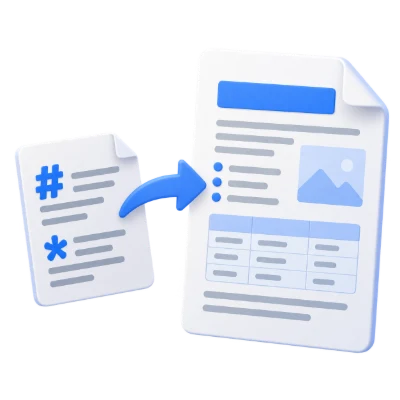
Turn a README, installation notes or release brief into a PDF with readable headings, code blocks and tables.
Organize notes with headings, lists and quotations, then choose readable type and margins for a downloadable copy.
Convert working Markdown into a proposal outline, meeting summary or report with a consistent document style.
Start writing immediately or open one .md, .markdown or .txt file.
Use Start writing for a blank editor, Upload Markdown for a file, or Try an example to explore headings, lists, tables, code and links. UTF-8 and UTF-16 text files are supported.
The editor preserves Markdown source separately from the formatted preview. Copy copies the source. The .md button saves the source with uploaded images embedded, so they reappear when you reopen that file here. Document style settings are not saved in the source.
Use clear toolbar controls for headings, emphasis, lists, images, tables, code and equations.
Choose H1–H6 or Paragraph from the heading menu. The toolbar adds bold, italic, underline, strikethrough, numbered or bullet lists, quotes, links, images, tables, code blocks, equations and horizontal rules. Heading and list actions format the selected lines. Underline uses a safe <u>text</u> extension; other raw HTML stays plain text.
Use Insert image to choose a PNG or JPG from your device. It appears in the live preview and finished PDF, fitted within the page. Uploaded images are resized to a maximum of 2,048 pixels on their longest side. External image URLs are not fetched; their alt text is shown instead. Safe web and email links remain clickable. Diagram extensions, custom LaTeX packages and external resources inside equations are not supported.
Write inline equations between $...$ or \(...\), and display equations between $$...$$ or \[...\]. A fenced code block labeled math also renders as an equation. Use the equation toolbar button to insert a starting formula. Fractions, roots, sums, integrals, matrices and aligned equations are supported; invalid expressions are highlighted before PDF creation. This is LaTeX math support, not compilation of full .tex projects.
Use Write, Split view or Preview to focus on the source or the document.
Split view shows source and preview together on a wide screen. On a phone or narrower workspace, switch between Write and Preview. Focus preview hides the source editor. Fit sizes a page to both the available width and height; longer content remains scrollable. Preview changes stay on your device until you create the PDF.
The preview shows continuous content at the chosen page width. Final pagination, repeated table headers and page numbers are produced when you create the PDF, so check the finished PDF for page breaks.
Choose one of six font-led styles, or customize any of the 26 font families, type size, line spacing and margins.
Select a font family, a size from 6 to 32 points and line spacing. Set A4, Letter, A5 or A3 paper, portrait or landscape orientation, and narrow through wide margins. Add page numbers if needed.
Search the font picker by name and compare typeface samples before selecting. Choices include Roboto, Montserrat, Lato, Inter, Poppins, Merriweather and Arabic fonts. The selected font is used in the preview and embedded in the PDF; Arabic text uses a suitable Arabic fallback when the selected Latin font does not include it.
Start with README (Roboto), Business (Montserrat), Academic (Libre Baskerville), Magazine (Playfair Display), Product docs (Inter) or Technical (Fira Sans). Each sets a starting font, size, spacing and matching heading, table and quote styles. You can adjust the settings afterward without changing your Markdown.
Choose automatic, left-to-right or right-to-left reading direction.
Automatic direction detects the direction of individual text blocks. Force right-to-left for an Arabic document or left-to-right for a Latin-script document. Code blocks keep left-to-right layout.
Arabic and Hebrew fallback fonts are included in the PDF rendering path. Use the preview to inspect mixed-script links, numbers and table alignment; font substitution and line wrapping can affect the layout.
PDF creation runs on our servers only when you choose Create PDF.
After conversion, use Download or Preview. Back returns to your Markdown and settings so you can revise and create another copy. Save the .md source before closing the page if you want to continue later.
The tool accepts one source file up to 10 MB, with at most 500,000 source characters and 200 PDF pages. Add up to 20 PNG or JPG images, each up to 50 MB and 10,000 × 10,000 pixels before resizing, with a combined embedded size of 4 MB. Source editing and preview run locally. Create PDF sends the source and its referenced images to our servers; temporary files and results follow our retention policy.
Upload a supported text file or paste content, up to 10 MB after decoding. Generated PDFs are limited to 200 pages. Structure, layout and memory limits also apply.
The source is limited to 500,000 characters. Deeply nested or very complex Markdown can reach structure or processing limits sooner. External images are not fetched.
Processing uses our servers. Source files, temporary files and results are deleted from our servers within 30 minutes after processing finishes. We do not share document contents with third parties or use them to train AI models.
Know what to expect before you start.
Secure processingOpen a .md, .markdown or .txt file, or choose Start writing. Edit the source, review the live preview and choose a document style and page settings. Click Create PDF, then preview or download the result.
Yes. You can write, preview and convert Markdown to PDF for free without creating an account.
Yes. Markdown headings, lists, emphasis, blockquotes, pipe tables, inline code and fenced code blocks are supported. Code keeps a monospace style, and safe web or email links remain clickable in the PDF.
Yes. Upload PNG or JPG images with Insert image to include them in the preview and PDF. External image URLs remain alt text. Underline supports <u>text</u>; other raw HTML stays plain text. LaTeX equations work inline with $...$ or \(...\), and in display blocks with $$...$$ or \[...\]. Fenced math blocks also work. Invalid equations are highlighted. Full .tex projects, custom packages and Mermaid diagrams are not compiled.
No. The live pane is a continuous preview at your selected page width. Final page breaks and page numbers are applied during PDF creation. Use Preview on the result screen to inspect the finished pages.
Yes. Arabic font support and automatic or explicit right-to-left direction are available. Code blocks remain left-to-right. Review the preview when a paragraph or table mixes Arabic, Latin text and numbers.
Open one .md, .markdown or .txt file up to 10 MB. The source can contain up to 500,000 characters and the result up to 200 PDF pages. Complex or deeply nested documents may reach processing limits earlier.
Save the .md file to keep your source and uploaded images, then reopen it here later. PDF style settings are not stored in that file. Writing and preview stay on your device. Create PDF sends the source and its referenced images to our servers. Files are deleted within 30 minutes after processing, and document contents are not shared or used for AI training.