


Office work
Continue in another document format
Choose Word or PowerPoint and review the result before editing or sharing.
Choose your PDF, pick an output format, and continue with the right converter.
Use the page controls to inspect your document.
Save your result or return to adjust the settings.
Choose one PDF, drag it here, or try the sample.
Choose a format card and press Next to open its converter.
Adjust the destination tool’s settings, start conversion and download the result.
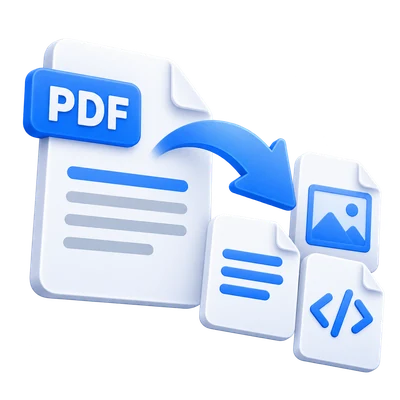
Start with a PDF and choose what you want to create. This launcher brings the supported output formats together, then opens the dedicated converter with your file ready.
Choose Word or PowerPoint and review the result before editing or sharing.
Choose a page-image format for use in a presentation, website or image workflow.
Choose structured JSON/XML data or CAD output suited to your source.
One set of choices for documents, images, data and drawings.
Choose Word, PowerPoint, TXT, Markdown, HTML or fixed-layout EPUB; JPG, PNG, TIFF, WebP, SVG, GIF, BMP or HEIC images; or JSON, XML, DWG, DXF, DICOM, PS and EPS. Each card opens an existing dedicated converter.
Choose a format here, then review the options in its own workspace.
Selecting a card does not navigate or start conversion. Next opens the chosen tool with your PDF already loaded, in the same language. Review available page selection and output options there before starting and downloading the result. Next opens the chosen converter. Some tools, such as PDF to Text, upload the PDF to prepare a preview when they open. Review the destination’s settings and processing information before downloading.
Images, selectable text and vector drawings have different conversion results.
Converting scanned pages to an image format preserves their appearance. Selecting Word, TXT or a CAD format does not add OCR or turn a scanned drawing into vector geometry. For editable scanned text, use PDF OCR first. Review the finished output: layout and editability depend on the source and chosen converter.
The browser transfers the file without putting its contents in the URL.
The launcher temporarily stores the PDF in your browser for a one-use transfer to the selected tool. The selected format’s file-size limit is checked before Next. The destination checks its own page and processing limits. If browser storage is unavailable, open the converter using the recovery link and choose the PDF there. Later conversion follows the destination tool’s processing policy.
Choose one PDF up to 300 MB. Each output converter applies its own file-size, page and processing limits.
Routing happens on your device. The destination tool explains whether its own processing stays local or uploads files to our servers. Review its settings before starting.
Know what to expect before you start.
Choose your converterChoose Word, PowerPoint, TXT, Markdown, HTML or fixed-layout EPUB; JPG, PNG, TIFF, WebP, SVG, GIF, BMP or HEIC images; or JSON, XML, DWG, DXF, DICOM, PS and EPS. Each card opens an existing dedicated converter.
Selecting a card does not navigate or start conversion. Next opens the chosen tool with your PDF already loaded, in the same language. Review available page selection and output options there before starting and downloading the result. Next opens the chosen converter. Some tools, such as PDF to Text, upload the PDF to prepare a preview when they open. Review the destination’s settings and processing information before downloading.
Converting scanned pages to an image format preserves their appearance. Selecting Word, TXT or a CAD format does not add OCR or turn a scanned drawing into vector geometry. For editable scanned text, use PDF OCR first. Review the finished output: layout and editability depend on the source and chosen converter.
The launcher temporarily stores the PDF in your browser for a one-use transfer to the selected tool. The selected format’s file-size limit is checked before Next. The destination checks its own page and processing limits. If browser storage is unavailable, open the converter using the recovery link and choose the PDF there. Later conversion follows the destination tool’s processing policy.