
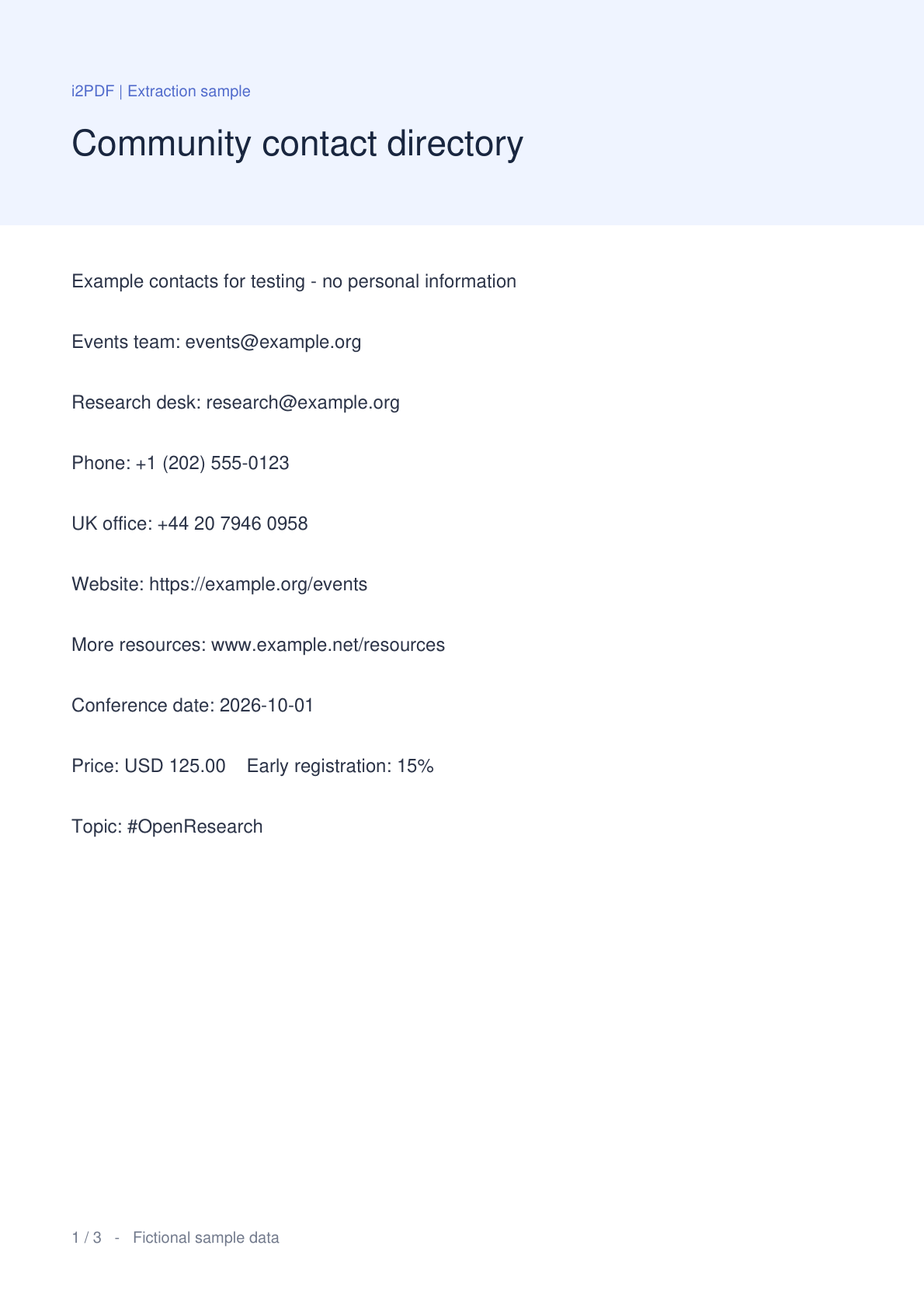
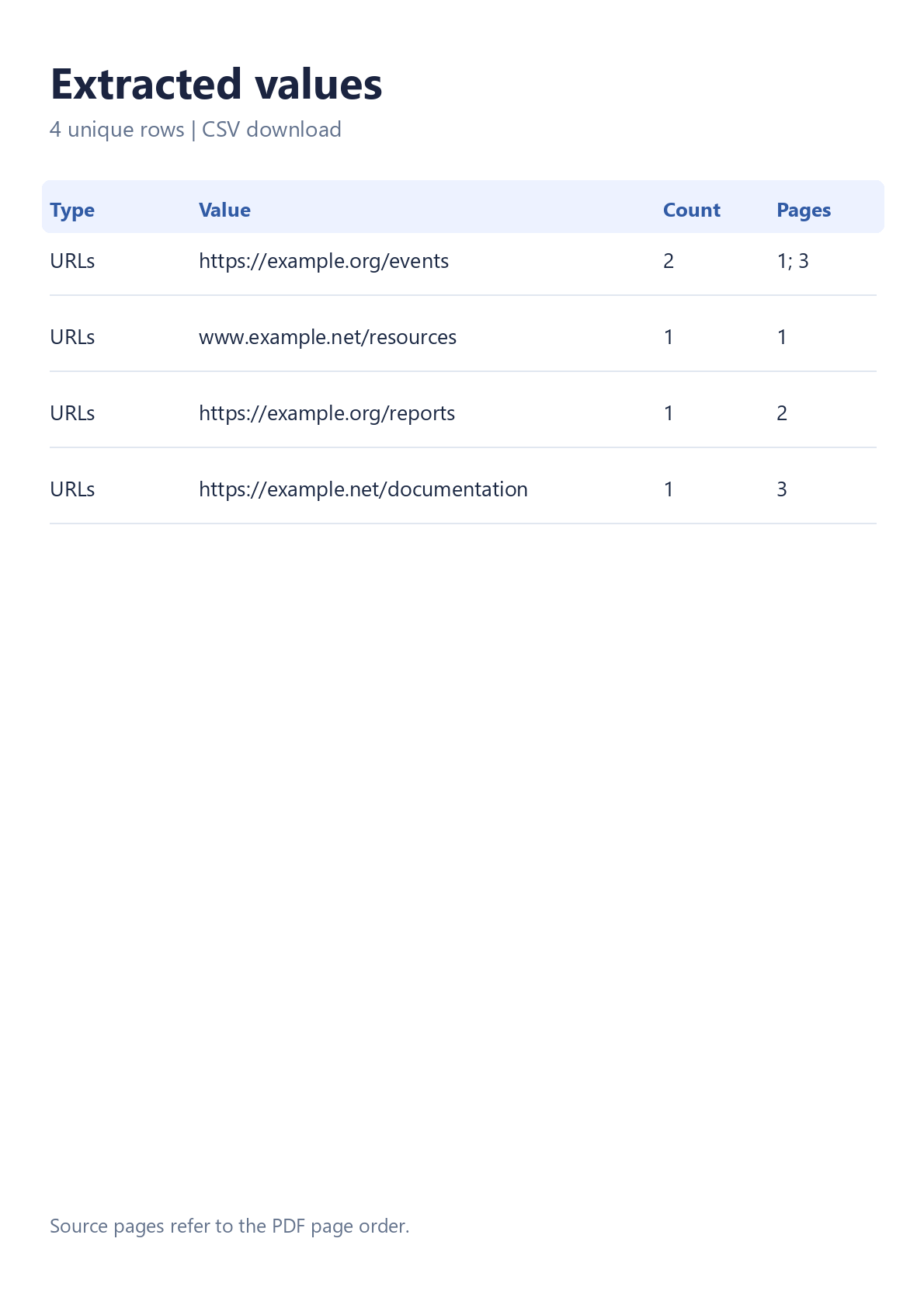

Open Extract Links from PDF to collect values from one PDF without copying them line by line. The comparison uses the real sample document and a CSV downloaded from the tool. The three-page sample produces 4 unique web addresses from 5 occurrences.
Open your PDF
Upload one PDF, or select Try sample to follow this example. The PDF preview and page thumbnails appear. Your original file stays unchanged, and extraction runs in your browser.
A text-based directory, report, research paper or brochure is a useful starting point. Image-only scans need OCR before their printed text can be recognized.
Choose the useful options
On a phone, open Settings. On desktop, use the settings panel beside the preview.
Keep Remove duplicates enabled to group repeated targets. Choose CSV when you need page references, or TXT for a plain URL list. The example uses the default CSV format and source order.
Extract and check the matches
Select Extract. When processing finishes, the Results tab shows the values, occurrence counts and source pages. Select a circular page number to inspect its location in the PDF preview, then return to Results.
The sample includes https://example.org/events twice and three other web addresses. It also demonstrates a clickable link whose visible label is different from its target. A printed URL and its identical clickable target on the same page are not counted twice.
Use Filter results to narrow the list. Copying and downloading include all matching rows, even when the result table spans several screens of rows.
Download CSV or TXT
Select Download CSV, then use the main Download button on the ready screen. CSV contains Type, Value, Count and Pages columns. TXT and Copy all contain one value per line.
CSV values that could be interpreted as spreadsheet formulas are protected with a leading apostrophe. For example, an international phone number begins with a plus sign. Use TXT if you need a plain list without spreadsheet protection.
Common questions
Can this find a link behind words such as “Read more”?
Yes, when those words have a supported HTTP or HTTPS link annotation in the PDF. The exported value is its web destination. A visual underline alone does not prove that a clickable link exists.
What should I do with a scanned PDF?
Run PDF OCR first, then load the recognized copy into this tool. Check OCR output carefully: a mistaken character can change an address or identifier.
What are the extraction limits?
Use one PDF up to 50 MiB and 750 pages. Extraction is bounded to 20,000 matches overall and 2,000 per page, with a 90-second processing budget. Text and annotation limits also apply. If a limit or unreadable page interrupts the scan, the tool shows a partial-results notice and marks the export filename as partial.
Are my PDF links opened automatically?
No. Extraction reads the file in the browser and does not visit extracted destinations. Page buttons navigate within the PDF preview.
Keep the values and their context
Extract a focused list, check the source pages, and download the format that suits your next step.